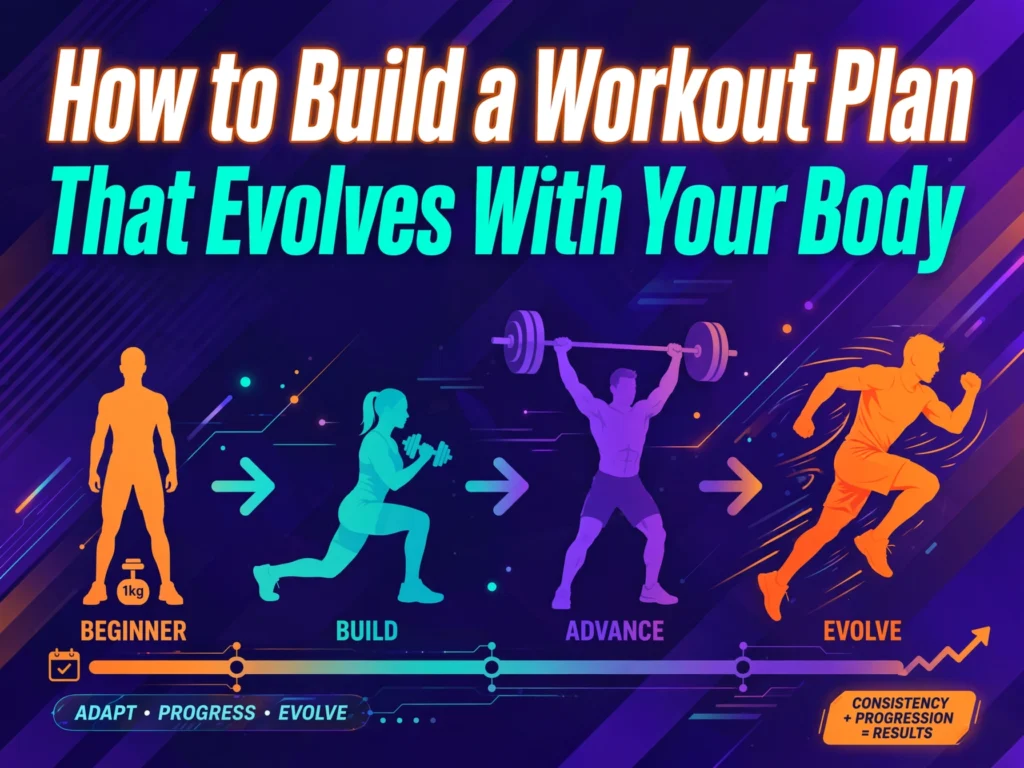
How to Build a Workout Plan That Evolves With Your Body
The Forever Workout: How to Tailor Your Exercise Routine for Long-Term Health (At Any Age)
Let’s start with a question that might sting a little: Do you exercise the same way today as you did five years ago?
If the answer is yes, you might be doing yourself a disservice.
Here is the uncomfortable reality that most fitness magazines won’t tell you: Your body is not a static machine. It changes. Your metabolism slows, your joints become less forgiving, your hormones shift, and your recovery time stretches out. The workout that was perfect for you at 25 could actually be harmful at 45—and the workout that works at 45 might be completely inadequate at 65.
Long-term health isn’t about finding one routine and sticking to it forever. It is about evolution. It is about listening to the subtle whispers of your body and adjusting your movement to match where you are right now—not where you were a decade ago.
This guide isn’t about chasing six-pack abs or running marathons. It is about building a fitness strategy that keeps your heart strong, your bones dense, your mind sharp, and your body independent for as many decades as possible. Let’s break it down by age, metabolism, and goals.
The Golden Rule Before We Begin: Movement Is Medicine, But Dosage Matters
Think of exercise like a prescription drug.
If you take too little, it won’t work. If you take too much, you get side effects (injuries, burnout, hormonal crashes). The right “dose” depends on the patient—and you are the patient.
Before we dive into the age-specific details, here is the universal non-negotiable for long-term health:
- Strength training: At least 2 sessions per week. Why? Because muscle mass is your metabolic currency. It burns calories at rest, protects your joints, and prevents sarcopenia (age-related muscle loss).
- Cardiovascular exercise: At least 150 minutes of moderate-intensity activity per week (that is just 22 minutes a day). This keeps your heart, lungs, and blood vessels young.
- Flexibility and balance: At least 10 minutes daily. This is the insurance policy that keeps you from falling—and falling is the number one cause of disability in older adults.
Now, let’s tailor this to where you are in your life journey.
Your 30s: The “Build the Bank Account” Phase
If you are in your 30s, you are in the prime of your metabolic life. Your muscle mass is still high, your joints are still resilient, and your recovery is relatively quick.
Your long-term goal: Build as much lean muscle mass and bone density as you possibly can. This is your “retirement fund” for your 50s and 60s.
What to focus on:
- Heavy compound lifts: Squats, deadlifts, push-ups, and pull-ups. These stimulate the most muscle fibers and release growth hormones that keep you youthful.
- High-intensity interval training (HIIT): 2 days a week of short, intense bursts (sprints, burpees, kettlebell swings) to max out your cardiovascular capacity and boost your metabolism.
- Don’t neglect flexibility: Your 30s are when tight hamstrings and stiff shoulders start to become noticeable. Add a 15-minute yoga or dynamic stretching routine at the end of your workouts.
The metabolic twist:
Your metabolism is still forgiving. You can get away with a little more intensity and volume. But do not fall into the trap of “revenge workouts”—three-hour gym sessions that crush your nervous system. Keep your strength sessions to 45 minutes max, and you will build a foundation that lasts.
Your 40s: The “Switch to Sustainable” Phase
Welcome to the decade where recovery becomes a four-letter word. Your metabolism begins its natural slow-down—roughly 2–3% per decade—and your joints start to whisper warnings.
Your 40s are not about competing with your 20-year-old self. They are about outsmarting time.
What to focus on:
- Moderate-heavy strength: You still need weight training, but shift to moderate weights with higher repetitions (10–15 reps). This protects your joints while still building muscle.
- Low-impact cardio: Your knees will thank you. Swap running for elliptical machines, swimming, cycling, or incline walking. These elevate your heart rate without pounding your cartilage.
- Mobility becomes your priority: Tight hips and a rounded upper back are common in your 40s due to desk work. Add a dedicated 10-minute mobility routine before every workout. Think hip circles, cat-cow stretches, and shoulder dislocates.
The metabolic twist:
Your metabolism is slowing, but it is not helpless. The best way to combat this is to increase your daily “non-exercise activity thermogenesis” (NEAT). That means simply moving more during the day—taking the stairs, parking further away, walking during phone calls. This burns calories without adding stress to your joints.
Your 50s and 60s: The “Maintain and Protect” Phase
This is the decade where the “use it or lose it” principle becomes literal. Muscle loss accelerates, bone density drops, and balance becomes fragile.
But here is the good news: Exercise is the only “fountain of youth” that actually works. Studies show that older adults who strength train consistently have the bone density of people 20 years younger.
What to focus on:
- Functional strength: Stop worrying about bicep curls. Start worrying about your ability to lift a suitcase, stand up from a low chair, and carry groceries. Exercises like squats, lunges, step-ups, and farmer’s carries are gold.
- Balance work: This is non-negotiable. Stand on one foot while brushing your teeth. Practice heel-to-toe walking. Do single-leg balances. Falling is a medical emergency at this age, and balance training is the cheapest insurance you can buy.
- Gentle cardio: 30 minutes of brisk walking, water aerobics, or stationary cycling most days. Keep your heart rate in a comfortable zone—you should be able to talk while moving.
The metabolic twist:
Your metabolism is noticeably slower, and your muscle mass is shrinking faster. The solution? Protein timing. Eat a high-protein meal (30–40 grams) within an hour after your strength workouts to maximize muscle repair. And never skip your strength sessions—the weight loss you achieve through cardio alone will not preserve your muscle.
Your 70s and Beyond: The “Preserve Independence” Phase
At this stage, exercise is not about looking good—it is about staying independent. It is about being able to tie your own shoes, get out of a car without help, and play with your grandchildren.
What to focus on:
- Light resistance bands: Heavy dumbbells are not necessary. Resistance bands are gentle on joints but provide enough tension to keep muscles active.
- Seated exercises: If balance is a concern, do your strength work in a sturdy chair. Seated rows, seated leg extensions, and seated marches are all effective.
- Daily walking: 15–20 minutes of walking twice a day is far better than one long walk. It keeps your circulatory system active without exhausting your energy reserves.
- Stretching and yoga: Gentle, restorative yoga or tai chi is exceptional for maintaining flexibility and preventing falls.
The metabolic twist:
Your body’s calorie needs have dropped significantly. Instead of focusing on “burning calories,” focus on nutrient density. Eat to fuel your workouts, not to cut weight. Your exercise goal is maintenance, not transformation.
The One Universal Truth: Your Metabolism Is Not Your Enemy
Many people in their 40s and 50s blame their “slow metabolism” for weight gain. But here is a shocking fact: Your metabolism doesn’t actually slow down until after age 60.
The real culprit? Loss of muscle mass. Muscle is metabolically active tissue—it burns calories even when you are sleeping. When you lose muscle, your body requires fewer calories to maintain itself.
The solution is not to eat less. The solution is to lift more.
If you are over 40 and you are not strength training, you are actively accelerating your own metabolic decline. It is never too late to start—even a 75-year-old with no training experience can build significant muscle in just 12 weeks of consistent resistance work.
Your Action Plan: How to Tailor Based on Your Personal Goals
Not everyone wants the same outcome. Here is how to adjust your routine based on what matters most to you:
Goal 1: Weight Loss
- Focus: Cardio + Strength combo.
- Weekly structure: 4 days of strength training (moderate weights, higher reps) + 3 days of steady-state cardio (walking on an incline or cycling).
- Key tip: The magic happens in the afterburn effect. Strength training keeps your metabolism elevated for up to 48 hours post-workout.
Goal 2: Building Strength (for Function or Aesthetics)
- Focus: Heavy compound lifts.
- Weekly structure: 3 days of heavy strength (low reps, 5–8 reps per set) with 2 days of active recovery (walking or light yoga).
- Key tip: Progressively overload. Every 2 weeks, add a tiny amount of weight or one extra rep. Slow progress is still progress.
Goal 3: Improving Heart Health and Longevity
- Focus: Zone 2 cardio + Mobility.
- Weekly structure: 5 days of 30-minute Zone 2 cardio (where you can hold a conversation comfortably) + 10 minutes of daily stretching.
- Key tip: Zone 2 cardio is the sweet spot for longevity. It strengthens your mitochondria—the power plants of your cells—and reduces inflammation.
The 3 Warning Signs That Your Routine Needs a Tweak
Your body will tell you when something is wrong. Don’t ignore these signals:
- Persistent joint pain that doesn’t go away after a warm-up: That is not “good pain.” That is inflammation. Swap to a lower-impact option.
- You are exhausted all the time: Overtraining leads to cortisol spikes, which actually cause fat storage and muscle breakdown. Add an extra rest day.
- You stopped seeing progress after 8 weeks: Your body has adapted. It is time to change the exercises, increase the weight, or add a new variation.
The Bottom Line: Your Workout Should Age With You
Exercise for long-term health is not about bragging rights. It is not about posting a sweaty selfie or hitting a new personal best every single week.
It is about showing up, consistently, for decades.
The 25-year-old who pushes hard is smart. The 55-year-old who still pushes—but smarter, with more recovery, more mobility, and more self-awareness—is a legend.
So, take a honest look at your current routine. Ask yourself: Is this helping me thrive in my current decade? If the answer is no, make a tweak. Add a stretch. Reduce the weight. Walk more.
Your body is not a machine. It is a living, breathing ecosystem that rewards care, not punishment. Treat it like the beautiful, ever-changing gift that it is—and it will carry you far into a vibrant, independent future.
Now, go move. Your future self is counting on you.