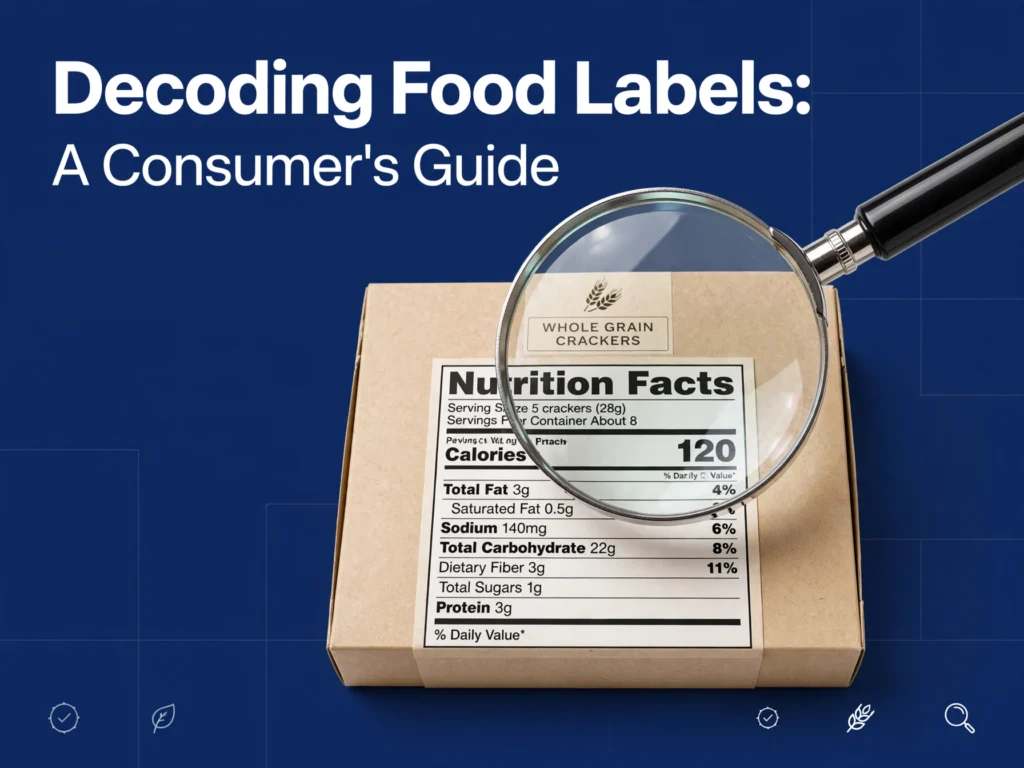
Decoding Food Labels: A Consumer’s Guide
Imagine this: You are standing in the grocery store aisle, holding two boxes of granola. Both say “natural” on the front. One has a picture of a happy farmer; the other has a sleek, modern design. You pick the one with the farmer because it feels healthier.
But here is the uncomfortable truth: Food packaging is designed to sell you a story, not to tell you the truth. The front of the box is basically a billboard. The real story—the one that determines whether that food is fueling your body or slowly sabotaging it—is hidden on the back.
Decoding a nutrition label isn’t rocket science. It is actually a simple detective game. Once you know where to look and what to ignore, you will never be fooled by slick marketing again. And the best part? You will walk out of the store with foods that actually make you feel good, without spending extra time in the aisles.
Step 1: Walk Past the Front of the Box
This is the hardest rule to follow, but it is the most important. Ignore every claim on the front. Words like “natural,” “wholesome,” “light,” “made with real fruit,” and “low-fat” are regulated very loosely—or not at all.
For example, a cereal box might say “made with whole grains” and feature a bright orange slice. But if you flip it over, you might find that the first ingredient is refined sugar, and the “whole grain” is a tiny fraction.
The front is a distraction. Your mission starts when you turn the package around.
Step 2: The Ingredient List – The Ultimate Truth-Teller
The ingredient list is the one section that cannot lie. By law, ingredients are listed in order of weight, from the largest amount to the smallest.
Here is your cheat code: The first three ingredients make up the majority of the food. If sugar, high-fructose corn syrup, or refined flour are in the top three spots, put the box back on the shelf. Period.
How to Spot “Hidden” Sugar (It Has Many Aliases)
Here is where manufacturers get sneaky. They don’t just write “sugar.” They split the sugar into multiple different names so that sugar doesn’t appear in the top spot. Keep an eye out for these imposters:
- Agave nectar (yes, even the “healthy” ones)
- Brown rice syrup
- Cane juice or cane syrup
- Corn syrup and high-fructose corn syrup
- Dextrose, maltose, and glucose
- Fruit juice concentrate (this is essentially liquid sugar)
- Honey and maple syrup (natural, but still sugar)
If you see three or four of these listed together, that product is a sugar bomb disguised as health food.
How to Spot Hidden Salt
Sodium hides in places you would never expect. Think sweet cereals, breads, canned soups, and even salad dressings. Look for these words:
- Sodium bicarbonate (baking soda)
- Disodium phosphate
- Monosodium glutamate (MSG)
- Sodium nitrate or nitrite (common in deli meats)
If a product has more than 20% of your daily sodium allowance per serving, it is heavily processed. Put it down.
How to Spot Unhealthy Fats
Not all fats are bad. In fact, your brain needs healthy fats. But you want to avoid these two troublemakers:
- Hydrogenated oils or partially hydrogenated oils: These are the primary sources of trans fats. Even if the label says “0g trans fat,” if you see hydrogenated oil on the list, it contains trace amounts that are still damaging to your heart.
- Palm oil or vegetable oil: These are heavily refined and high in saturated fat. If you see these near the top, the product is likely not the healthiest choice.
Step 3: The Nutrition Facts Panel – The Numbers That Matter
Now, flip to the black-and-white box. It looks intimidating, but you only need to focus on four specific numbers. Forget the rest for now.
1. Serving Size (The Biggest Trap)
This is the most deceptive number on the whole label. A bag of chips might say “200 calories per serving.” Sounds reasonable, right? But then you look at the serving size: “About 9 chips.” Who on earth eats only 9 chips?
Your move: Always check the serving size first. Then, multiply the calories, sugar, and salt by the number of servings you actually plan to eat. You might be shocked to find out that your “healthy” juice has 40 grams of sugar because the bottle counts as 2.5 servings.
2. Added Sugars (The New Hero)
In recent years, the FDA added a separate line for “Added Sugars.” This is a game-changer.
- Total Sugars includes naturally occurring sugars (like lactose in milk or fructose in fruit).
- Added Sugars tells you exactly how much extra sweetener was dumped in during processing.
Your goal? Look for products with less than 5 grams of added sugar per serving. If it has 10 or 15 grams, it is essentially candy.
3. Sodium (The Silent Bloat)
The American Heart Association recommends less than 2,300 mg of sodium per day, but ideally closer to 1,500 mg.
When reading a label, look for the “% Daily Value” column. If a product has 20% or more of the daily value for sodium, it is extremely high. That doesn’t mean you can never eat it, but it does mean you should balance it with low-sodium meals for the rest of the day.
4. Fiber (The Unsung Hero)
Here is a little trick: High fiber is usually a sign of high quality.
Check the dietary fiber number. If the product has 3 grams or more of fiber per serving, it likely contains whole grains, seeds, or legumes. If it has less than 1 gram, it is likely stripped of all its nutrients. Fiber slows down sugar absorption, keeps you full, and feeds your gut bacteria. The more, the better.
Step 4: The “3-Second Rule” for Busy Shoppers
If you don’t want to read every single word on every package, use this simple “3-second filter” to quickly eliminate the junk:
- Check the sugar: If “Added Sugars” is over 10 grams, skip it.
- Check the sodium: If “% Daily Value” is over 20%, skip it.
- Check the ingredient list: If you see a word you cannot pronounce, or if sugar appears in the top three spots, skip it.
If a product passes all three of those checks, it is worth considering. If it fails any one of them, it is probably not going to help you hit your health goals.
Common Food Label Lies (And the Truth Behind Them)
Let’s debunk a few more traps that trip up even experienced shoppers.
Lie 1: “Zero Grams of Trans Fat”
The Truth: By law, if a product has less than 0.5 grams of trans fat per serving, the label can say “zero.” However, if the ingredient list says “partially hydrogenated oil,” you are still eating trans fats. Read the ingredients, not the bold “zero” claim.
Lie 2: “Made with Real Fruit”
The Truth: This usually means the product contains a tiny amount of fruit juice concentrate or fruit puree, but it is often mostly sugar and starch. Look at the ingredient list to see where the fruit actually ranks.
Lie 3: “Organic” Means Healthy
The Truth: Organic sugar is still sugar. Organic potato chips are still fried in oil. Organic is great for the environment, but it doesn’t automatically make a food good for your waistline. Always check the nutrition facts, even on organic items.
The Ultimate Shopping Mindset
Decoding food labels isn’t about being paranoid or never eating anything enjoyable. It is about conscious choices.
When you know what is actually inside that granola bar, you can decide if it is worth it. Sometimes, a sugary treat is exactly what you need after a long workout. That is fine! But the problem occurs when we eat those treats thinking they are health foods.
Knowledge is power, but in this case, knowledge is also energy, focus, and long-term wellness.
So, the next time you step into a grocery store, remember: You are the detective. The ingredients are your clues, and the nutrition panel is your case file. Don’t let a pretty box and a smiling farmer trick you into buying a product that works against your body.
Flip that package. Read those three lines. And walk out with confidence knowing that you are feeding your body exactly what it needs—nothing more, and nothing less.
Final Takeaway: Your Cheat Sheet for the Next Grocery Trip
| What to Look For | What to Avoid |
|---|---|
| Ingredients with 5 or fewer items | Long lists with unpronounceable names |
| Added sugars under 5g per serving | Added sugars over 10g per serving |
| Fiber over 3g per serving | Fiber under 1g per serving |
| Sodium under 15% Daily Value | Sodium over 20% Daily Value |
| Whole grains or nuts as first ingredient | Sugar or refined flour as first ingredient |
Print this out, stick it in your wallet, and take it with you. Before you know it, decoding labels will become second nature—and your body will thank you with clearer skin, steadier energy, and better digestion.