How to Fix Your Posture Curve to Flat: The Ultimate Guide to a Neutral Spine
Have you ever caught a glimpse of yourself in a window or mirror and realized your back is hunched over, or your lower back is arched so far forward that your stomach protrudes? You are not alone. Millions of people struggle with postural deviations, often referred to as an excessive “posture curve.”
Whether you are dealing with a “tech neck” (upper back hunch) or an anterior pelvic tilt (lower back arch), living with an unnatural spinal curve can lead to chronic pain, tight muscles, and even joint issues down the road. The good news? Your posture is not permanently fixed. By understanding how your body works and implementing the right stretches and exercises, you can fix your posture curve to flat—achieving what physical therapists call a “neutral spine.”
In this comprehensive guide, we will break down exactly why your posture curve is exaggerated and provide you with a step-by-step roadmap to flatten it out safely and effectively.
Understanding the “Posture Curve”
Before we fix the problem, we need to understand it. It is important to note that your spine is supposed to have curves. A healthy spine has a natural “S” shape when viewed from the side.
However, when we talk about fixing a “posture curve to flat,” we are talking about correcting an excessive curve. The two most common culprits are:
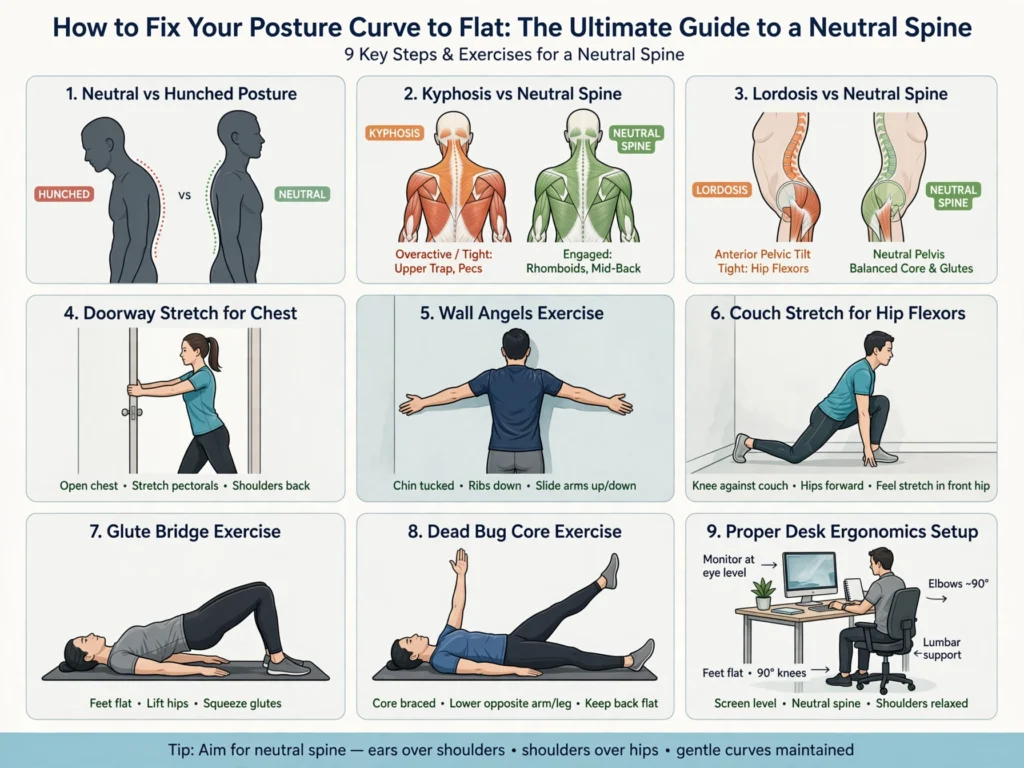
- Kyphosis (Upper Back Curve): Often called a hunchback or round shoulders. This is caused by slouching at a desk or constantly looking down at a phone. The chest muscles get tight, and the upper back muscles become weak and stretched out.
- Lordosis (Lower Back Curve): Often called a “duck posture” or anterior pelvic tilt. This happens when your pelvis tilts forward, creating a massive arch in your lower back. It is usually caused by sitting too much, which tightens the hip flexors and weakens the glutes and core.
To achieve a “flat” posture, our goal is to bring these excessive curves back to a neutral, natural alignment.
How to Fix the Upper Back Curve (Kyphosis)
If your shoulders roll forward and you have a hump at the top of your back, your goal is to open up the chest and strengthen the muscles that pull your shoulder blades back.
1. The Doorway Stretch (For Tight Chest Muscles)
Since slouching tightens your pectoral muscles, you need to stretch them daily.
- How to do it: Stand in a doorway and place your forearms against the doorframe, elbows bent at 90 degrees. Step one foot forward through the doorway until you feel a deep stretch across your chest. Hold for 30 seconds, breathing deeply. Repeat 3 times.
2. Wall Angels (For Upper Back Strength)
This exercise strengthens the rhomboids and lower trapezius muscles, which are responsible for holding your shoulders back.
- How to do it: Stand with your back flat against a wall. Your heels, glutes, upper back, and head should all be touching the wall. Raise your arms like a cactus (elbows bent at 90 degrees) and press the backs of your hands against the wall. Slowly slide your arms up the wall as high as you can without letting your lower back arch, then pull them back down. Do 3 sets of 10 reps.
3. Prone Y-T-W Raises
This is a fantastic exercise to wake up the weak upper back muscles.
- How to do it: Lie face down on the floor. Lift your chest slightly off the ground. Form a “Y” with your arms straight overhead, thumbs pointing up. Lower them, then form a “T” with arms out to the sides. Lower them, then bend your elbows to form a “W,” squeezing your shoulder blades together. Do 3 sets of 5 reps for each letter.
How to Fix the Lower Back Curve (Lordosis)
If your lower back arches deeply and you experience a dull ache after standing for a long time, you need to stretch your hip flexors and strengthen your glutes and core to pull your pelvis back to a neutral (flat) position.
1. The Couch Stretch (For Tight Hip Flexors)
Sitting all day shortens and tightens the muscles at the front of your hips, pulling your pelvis forward.
- How to do it: Kneel on the floor facing away from a couch or wall. Place your back knee against the wall and your foot pointing up the wall. Step your front foot forward into a lunge position. Squeeze the glute of the back leg and lean your hips slightly forward. You will feel an intense stretch in the front of your hip and thigh. Hold for 60 seconds per leg.
2. Glute Bridges (For Weak Glutes)
Your glutes act as a pulley to pull your pelvis backward into a flat alignment.
- How to do it: Lie on your back with your knees bent and feet flat on the floor. Flatten your lower back against the floor by tilting your pelvis. Squeeze your glutes and push your hips toward the ceiling until your body forms a straight line from your knees to your shoulders. Lower slowly. Do 3 sets of 15 reps.
3. The Dead Bug (For Core Strength)
A strong core is the foundation of a flat posture.
- How to do it: Lie on your back with your arms extended toward the ceiling and your knees bent at 90 degrees (like an upside-down table). Press your lower back flat into the floor. Slowly lower your right arm and left leg toward the floor without letting your lower back arch. Return to the start and switch sides. Do 3 sets of 10 reps per side.
Daily Habits to Maintain a Flat Posture
Exercises alone won’t fix the problem if you spend the other 23 hours of your day ruining your posture. You must integrate these habits into your daily routine:
- Fix Your Desk Ergonomics: Ensure your computer monitor is at eye level so you aren’t looking down. Your feet should be flat on the floor, with your knees and hips at 90-degree angles.
- The 30-Minute Rule: Never sit for longer than 30 minutes at a time. Stand up, reach for the ceiling, and do a quick lap around your house or office.
- Mind Your Phone Usage: Stop looking down at your phone. Bring the phone up to eye level. It might look a little funny to others, but your neck will thank you.
- Sleep on Your Back or Side: Sleeping on your stomach forces your neck to twist and your lower back to arch. Sleep on your back with a pillow under your knees, or on your side with a pillow between your knees to keep your pelvis aligned.
Important Note: When to See a Professional
While most posture curves can be fixed with diligent stretching and strengthening, some cannot. If you have severe back pain, numbness or tingling in your legs, or if your posture curve is rigid (meaning you physically cannot straighten your back no matter how hard you try), you need to see a physical therapist or orthopedic doctor. You may have a structural issue like Scheuermann’s disease or scoliosis that requires professional medical intervention.
Final Thoughts
Fixing your posture curve to flat (neutral) doesn’t happen overnight. It took years of bad habits to create that excessive curve, and it will take consistent effort to correct it.
By performing the stretches and exercises outlined above daily and being mindful of how you sit and stand, you will gradually retrain your muscles. Within a few weeks, you will notice less pain. Within a few months, you will look taller, leaner, and more confident. Stick with it, listen to your body, and enjoy the benefits of a healthy, neutral spine!