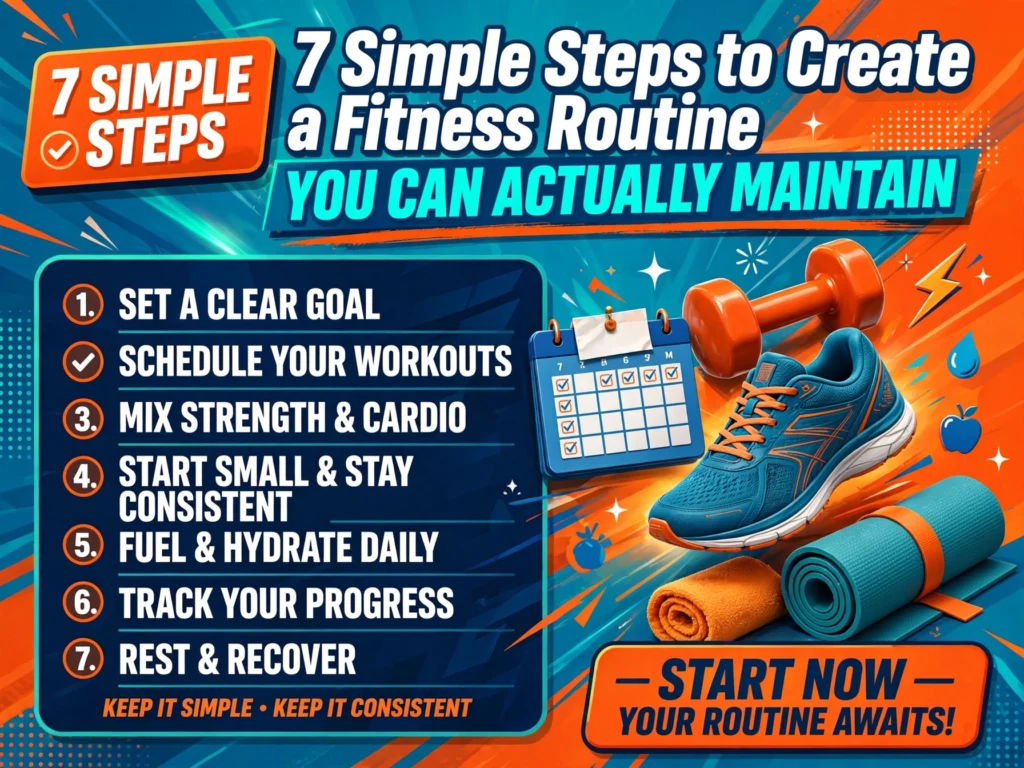
7 Simple Steps to Create a Fitness Routine You Can Actually Maintain
Let’s be honest. If you have ever typed “fitness routine” into a search bar, you have probably been hit with a tidal wave of chaos.
There is the 7-minute workout. The 30-day ab challenge. The “military” boot camp. The “hot girl walk.” The keto-kickboxing hybrid. Every influencer on the planet is selling you a different secret—and they all promise that their way is the only way to get results.
And yet, for most of us, these routines last about two weeks. Maybe three. Then, life gets busy, the motivation fades, and we feel guilty for “failing.”
Here is the hard truth that the fitness industry doesn’t want you to know: The best workout routine is not the one that is the most intense. It is the one you can actually do next week. And the week after. And the week after that.
This guide is not about turning you into a gym shark or a marathon runner overnight. It is about cutting through the noise, focusing on the timeless fundamentals, and building a sustainable fitness routine that fits into your actual life—not an influencer’s highlight reel.
Step 1: Define Your “Why” (Not Your “What”)
Before we talk about squats, running, or yoga mats, we need to talk about your north star.
Most people set goals like “lose 10 pounds” or “get abs.” These are outcome-based goals, and they are fragile. Why? Because if you don’t see results in two weeks, you quit.
Instead, shift to identity-based goals. Ask yourself: “What kind of person do I want to become?”
- “I want to be someone who has enough energy to play with my kids after work.”
- “I want to be someone who can hike a mountain without gasping for air.”
- “I want to be someone who feels strong and capable in my own body.”
When your fitness routine is tied to your identity, it stops being a chore and starts being a reflection of who you are. You don’t “have” to work out. You get to work out because it makes you the person you want to be.
Step 2: The “Three Pillars” of a Balanced Routine
Here is the secret that no fad diet will tell you: Your body needs three different types of movement to function optimally.
If you only lift weights, you become stiff and inflexible. If you only run, you lose upper-body strength and bone density. If you only stretch, you never build the muscle that protects your joints.
The sustainable routine is built on these three pillars:
Pillar 1: Strength Training (The Foundation)
Strength training isn’t just about bulging biceps. It is about building lean muscle mass, which boosts your metabolism, protects your bones, and prevents injuries.
The catch: You don’t need a gym membership or heavy dumbbells. Bodyweight exercises—like push-ups, squats, lunges, and planks—are incredibly effective for beginners. Aim for 2 to 3 strength sessions per week, with at least one rest day between them to allow your muscles to repair.
Pillar 2: Cardiovascular Training (The Engine)
Cardio is not about torturing yourself on a treadmill for an hour. It is about keeping your heart and lungs healthy.
The catch: You don’t need to “run” unless you want to. Brisk walking, cycling, swimming, dancing, or even mowing the lawn counts. The goal is to elevate your heart rate for a sustained period. Aim for 3 to 4 cardio sessions per week, lasting anywhere from 20 to 45 minutes.
Pillar 3: Flexibility and Mobility (The Glue)
This is the most neglected pillar. If your muscles are tight, your strength and cardio suffer. Tight hamstrings can ruin your squats. Stiff shoulders can ruin your push-ups.
The catch: You don’t need to be a yogi. Just spend 5 to 10 minutes after every workout doing static stretches for your hamstrings, quadriceps, chest, and back. Add one dedicated mobility session (like a 20-minute yoga flow or a foam-rolling session) per week.
Step 3: Start “Stupidly” Small (The 5-Minute Rule)
Here is the biggest mistake people make when starting a fitness routine: They go from 0 to 100 in one day. They do a 45-minute intense workout on Monday, feel sore on Tuesday, and never show up again on Wednesday.
The sustainable approach? Start smaller than you think you need to.
Try the “5-Minute Rule.” Commit to just 5 minutes of movement every day. That’s it.
- Day 1: 5 minutes of stretching.
- Day 2: 5 minutes of bodyweight squats and push-ups.
- Day 3: 5 minutes of walking around the block.
Why does this work? Because 5 minutes is never a struggle. You will always show up. And here is the magic: once you start, you will almost always want to keep going. That 5 minutes turns into 10, and then 15, and then a full workout.
But even if it only stays at 5 minutes, you have built a daily habit. And habits, not intensity, are what create long-term results.
Step 4: Schedule Your Workouts Like a Meeting (Not a Wish)
Motivation is unreliable. It comes and goes like the weather. But systems are reliable.
If you say, “I’ll work out when I have time,” you will never have time. Instead, put your workouts on your calendar—literally.
- Monday 7:00 AM: 20-minute strength session
- Wednesday 6:00 PM: 30-minute walk
- Friday 12:00 PM: 15-minute stretch break
Treat these appointments with the same respect you would treat a doctor’s visit or a work meeting. When your calendar says “Workout,” you don’t ask yourself if you feel like it. You just show up.
Step 5: Give Yourself a “Minimum” and a “Maximum”
Some days, you will wake up feeling full of energy. Other days, you will wake up with a headache and zero desire to move.
To handle this, give yourself a minimum and maximum for each workout:
- Minimum: The absolute lowest effort you will accept (e.g., 10 minutes of walking and 5 minutes of stretching).
- Maximum: The longest or hardest you will push yourself (e.g., 45 minutes of intense circuit training).
On a bad day, you hit your minimum. You still showed up. You still moved your body. On a great day, you hit your maximum. You feel like a superhero.
This removes the guilt and the “all-or-nothing” mentality that kills so many fitness journeys.
Step 6: Track Your Progress, Not Your Perfection
Do not weigh yourself every day. Do not obsess over how your abs look in the mirror. These are moving targets that shift with water weight, hormones, and lighting.
Instead, track performance-based progress:
- How many push-ups can you do this week compared to last week?
- Can you walk for 5 minutes longer without getting winded?
- Can you touch your toes a little deeper than you could a month ago?
These are real metrics of growth. They are objective, motivating, and far more rewarding than a number on a scale.
Step 7: The “Rest” Is the Part That Builds Muscle
This is a non-negotiable truth: Muscle is not built in the gym. It is built in the recovery room.
When you lift weights, you are actually creating microscopic tears in your muscle fibers. Your body repairs those tears during rest—and that repair process is what makes you stronger.
If you work out hard every single day, you never give your body time to rebuild. You end up fatigued, injured, and burned out.
Your recovery toolkit:
- Get at least 7–8 hours of sleep per night.
- Take at least one full “active rest” day per week (light walking or gentle stretching only).
- Eat enough protein and carbohydrates to refuel your muscles.
Step 8: What to Do When You Miss a Day (Because You Will)
Let’s get realistic: You are going to miss a workout. Maybe a sickness hits you. Maybe your toddler didn’t sleep. Maybe work demanded overtime.
Here is the rule: Never try to “make up” a missed workout. Do not do double the reps tomorrow. Do not punish yourself. That is a fast track to burnout and injury.
Instead, just pick up where you left off. If you missed Monday, just do Tuesday’s workout on Tuesday. The routine continues. A single missed day has zero impact on your long-term health. What matters is consistency over months and years, not perfection over days.
Your 4-Week Beginner Blueprint
If you don’t know where to start, here is a simple, balanced weekly schedule you can follow:
| Day | Focus | Suggested Activity |
|---|---|---|
| Monday | Strength (Upper Body) | Push-ups, tricep dips, dumbbell rows (or resistance bands) |
| Tuesday | Cardio + Mobility | 20-minute brisk walk + 5-minute full-body stretch |
| Wednesday | Strength (Lower Body) | Squats, lunges, glute bridges, calf raises |
| Thursday | Active Recovery | 30-minute yoga flow or gentle cycling |
| Friday | Full-Body Strength | Planks, burpees (modified), overhead press, squats |
| Saturday | Fun Cardio | Dancing, hiking, swimming, or playing a sport |
| Sunday | Complete Rest | Light walking only—your body deserves a break |
The Bottom Line: Slow and Steady Wins the Race
The fitness industry thrives on your impatience. It sells you quick fixes because it knows you want results now. But the human body doesn’t work that way. Real, sustainable change takes time.
The good news? You don’t have to be perfect. You don’t have to love every workout. You just have to show up, do the work, and trust the process.
In 6 months, you won’t even recognize the person who struggled to do 5 push-ups. Not because you transformed overnight—but because you made the decision, every single day, to invest in yourself.
So, lace up your shoes. Set that calendar reminder. And remember: The best workout routine is the one that outlasts the hype. And it starts with you, right now, exactly where you are.